
Consolation at the last

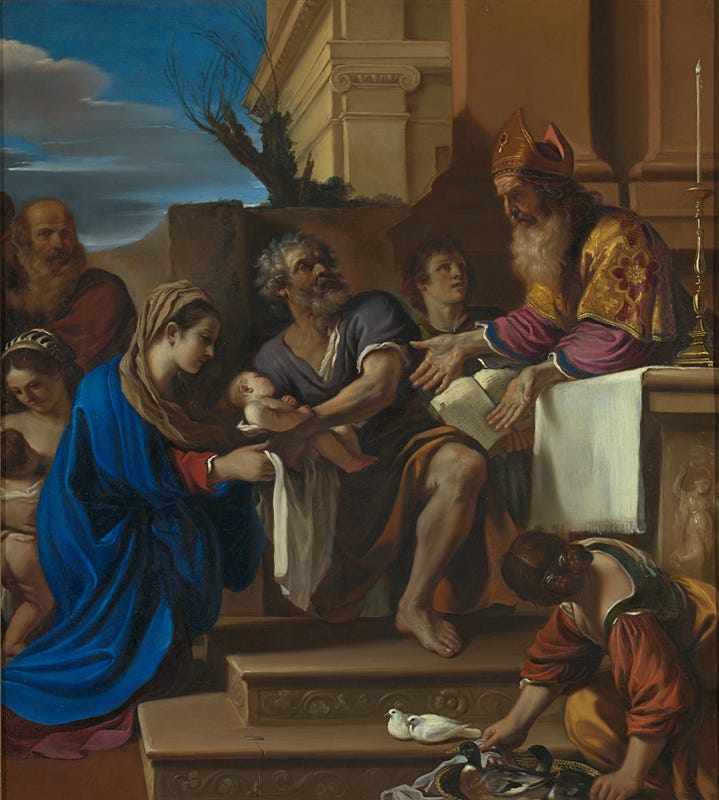
‘Now there was a man in Jerusalem whose name was Simeon; this man was righteous and devout.’
In our Gospel reading we are introduced to Simeon, a man whose name means ‘he has heard’ or ‘obedient one.’ And true to his name, he is said to be ‘righteous and devout.’ Yet at the same time we learn that Simeon was ‘looking forward to the consolation of Israel’. His obedience and devotion came with great hope for the future, great hope that God was a God of true strength and true power, a God who would fulfil his promises to his people.
In this sense, Simeon is waiting for all of history to be made right. Perhaps he thinks of the Roman occupation, this foreign military power which has garrisoned Jerusalem, or perhaps he examines his own heart—this just man, he looks inside himself and recognizes that for all of his devotion he was in need of forgiveness. Or perhaps he considers death, he knows that despite his piety there is, like Horace says, one night that waits for us all (Odes 1.XXVIII).
Saint Luke tells us that it was revealed to Simeon that ‘he would not see death before he had seen the Lord’s Messiah’. It’s a curious turn of phrase—as though death is a person or a place or a work of art. Simeon is told he will not see death until he first sees Christ.
We might say this is true of all Christians. We are all called to be obedient to God’s law—we’re called to be just and devout—and yet often our vices seem stronger than our virtues. However much we obey, we find ourselves like Simeon, looking forward to a future spiritual consolation.
It’s in this frame of mind that Simeon goes to the Temple in Jerusalem, this holy place where it was believed that the presence of God dwelt on earth. And it is here that he meets Joseph and Mary—this man and woman who, according to the law set down in Leviticus, have brought their first-born son, they’ve brought Jesus to present him to the Lord.
And Simeon is overcome with emotion. Somehow, he realises that this 40-day-old baby is Jesus, the Messiah. Simeon reaches out to him, takes him up in his arms, and he prays to God aloud:
‘Master, now you are dismissing your servant in peace, according to your word,
for my eyes have seen your salvation, which you have prepared in the presence of all peoples, a light for revelation to the gentiles and for glory to your people Israel’ (Lk 2.29-32).
Holding this baby, Simeon’s need for consolation has been fulfilled. Now he can look with peace at what awaits him.
Yet this peace is surprising. As Simeon has been told, once he has seen the Lord’s Christ, then he will see death. So how can he claim to leave the temple in peace?
Origen of Alexandria, a Christian theologian in the second and third centuries, also noticed this strange contradiction. He dealt with it by closely examining Simeon’s prayer, making the following observation:
‘Simeon knew that no one could release a man from the prison of the body with hope of life to come, except the anointed One whom he enfolded in his arms. Hence he also says to him, ‘Now you dismiss your servant, Lord, in peace. For, as long as I did not hold Christ, as long as my arms did not enfold him, I was imprisoned and unable to escape from my bonds.’ This is true not only of Simeon but of the whole human race. Anyone who departs from this world, anyone who is released from prison and the house of those in chains, to go forth and reign, should take Jesus in his hands. He should enfold him with his arms and fully grasp him in his bosom. Then he will be able to go in joy where he longs to go.’
As Origen understood it, Simeon the righteous and devout, this Simeon could depart in peace not because of his prayers or obedience or his many trips to the temple. Simeon had peace because of what he held in Christ.
And it is in search of this spiritual consolation that we too enter into the house of God. Here we find, as if by chance, this same Jesus—the divinely appointed king, appointed according to the word of God, publicly announced and standing before all people. He is a light, revealing to us the character and power of God the Father. And, in his life, death, and resurrection, he is the glory of God’s people in history. Holding on to him we have true forgiveness, and true courage to look upon what awaits us. And it is in this spirit that we pray this, our collect for this evening.
‘Almighty and everliving God, we humbly beseech thy Majesty, that, as thy only-begotten Son was this day presented in the temple in substance of our flesh, so we may be presented unto thee with pure and clean hearts, by the same thy Son Jesus Christ our Lord. Amen.’
Before the sermon the following passages were read aloud.
Malachi 3.1-5
See, I am sending my messenger to prepare the way before me, and the Lord whom you seek will suddenly come to his temple. The messenger of the covenant in whom you delight—indeed, he is coming, says the Lord of hosts. But who can endure the day of his coming, and who can stand when he appears?
For he is like a refiner’s fire and like washers’ soap; he will sit as a refiner and purifier of silver, and he will purify the descendants of Levi and refine them like gold and silver, until they present offerings to the Lord in righteousness. Then the offering of Judah and Jerusalem will be pleasing to the Lord, as in the days of old and as in former years.
Then I will draw near to you for judgment; I will be swift to bear witness against the sorcerers, against the adulterers, against those who swear falsely, against those who oppress the hired workers in their wages, the widow, and the orphan, against those who thrust aside the alien and do not fear me, says the Lord of hosts.
Luke 3.22-40
When the time came for their purification according to the law of Moses, they brought him up to Jerusalem to present him to the Lord (as it is written in the law of the Lord, “Every firstborn male shall be designated as holy to the Lord”), and they offered a sacrifice according to what is stated in the law of the Lord, “a pair of turtledoves or two young pigeons.”
Now there was a man in Jerusalem whose name was Simeon; this man was righteous and devout, looking forward to the consolation of Israel, and the Holy Spirit rested on him. It had been revealed to him by the Holy Spirit that he would not see death before he had seen the Lord’s Messiah. Guided by the Spirit, Simeon came into the temple, and when the parents brought in the child Jesus to do for him what was customary under the law, Simeon took him in his arms and praised God, saying,
“Master, now you are dismissing your servant in peace,
according to your word,
for my eyes have seen your salvation,
which you have prepared in the presence of all peoples,
a light for revelation to the gentiles
and for glory to your people Israel.”
And the child’s father and mother were amazed at what was being said about him. Then Simeon blessed them and said to his mother Mary, “This child is destined for the falling and the rising of many in Israel and to be a sign that will be opposed so that the inner thoughts of many will be revealed—and a sword will pierce your own soul, too.”
There was also a prophet, Anna the daughter of Phanuel, of the tribe of Asher. She was of a great age, having lived with her husband seven years after her marriage, then as a widow to the age of eighty-four. She never left the temple but worshiped there with fasting and prayer night and day. At that moment she came and began to praise God and to speak about the child to all who were looking for the redemption of Jerusalem.
When they had finished everything required by the law of the Lord, they returned to Galilee, to their own town of Nazareth. The child grew and became strong, filled with wisdom, and the favor of God was upon him.